
The NaPA project (2022–2024) investigated in a unique citizen-farmer-science approach which measures can measurably promote biodiversity on productive farmland. More than 50% of Germany's land area is used for agriculture – biodiversity conservation must therefore be anchored in the agricultural landscape itself, not only in protected areas.
KEY FINDINGS
The field is alive! Studies show measurable biodiversity on real-world farm plots.
Even on intensively farmed land under real-world conditions, a large number of species and individuals can be found. 270,000 animals captured and 2,600 different species documented in the project.
Flower strips work – reliably and under real-world conditions
Even simple measures for biodiversity promotion are effective across diverse locations, independent of the farming system. +50% increase in insect biomass documented.
Farmers want to!
There is a high willingness to work on solutions and research questions. Active co-design of the project and a 91% success rate: over 10,000 samples were collected by farmers.
Technological progress enables scalability
New methods such as AI-supported identification (Edapholog) and acoustic bird monitoring (AudioMoth) make area-wide biodiversity monitoring realistic – with significantly less effort than before.
Framework conditions determine acceptance
Entrepreneurial freedom and genuine income neutrality are prerequisites for broad and lasting implementation in practice.
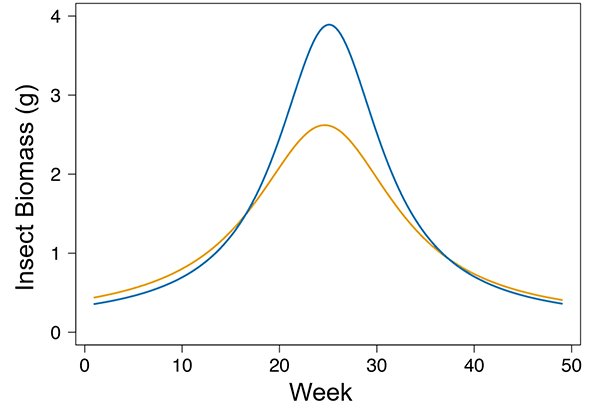
Trend of insect biomass (per trap) with (yellow) and without (red) flower strips, averaged across all three study years. A clear gain in insect biomass is evident with flower strips present. Distance is not accounted for here - the curves therefore represent averages across 0–100 m distance from the flower strip.
N=8,894, 17% explained variance, generalized additive model with Gamma distribution, random effect for farm. All effects are significant.
Some call modern farmland a biodiversity desert. 2,595 insect species on working farms in three countries: our data show the field is not dead. Between 'all is fine' and 'agricultural wasteland' lies a reality this project has made visible: an ecosystem that responds immediately to targeted support. Every measure counts.